How long do I have to register an out-of-state car in California?
Vehicle Code §4152.5 says that when California registration is required of a vehicle last registered in another jurisdiction, the application must reach the DMV within 20 days after registration became due. The application is treated as an original registration. The Driver Handbook puts the same deadline in plain language: you have 20 days after you become a resident or get a job in California.
DMV manual section 12.000 says registration becomes due when the owner becomes a California resident. The manual treats you as a resident when California is the state where you are registered to vote, where you work for wages or run a business, where you pay resident tuition, where your dependents attend school, where you claim a homeowner's property-tax exemption, where you rent or lease a residence, where you declared residency to get a license or other benefit, or the state that issued the driver license you carry. Military personnel are not treated as gainfully employed in California even if they also hold a civilian job. A vehicle that is based here, or used on California highways more than in any other single state, still has to be registered here even if the owner is a nonresident (Vehicle Code §4000.4, cited in the same manual section).
DMV manual section 12.045 says penalties are due if the fees are not paid within those 20 days. On the fee table checked October 2, 2026, a vehicle that has never been registered in California and is one year or less late owes a penalty of 40 percent of the vehicle license fee due for that year, and 40 percent of any weight fee. HTVR 9, the DMV's out-of-state how-to, says to submit the application and the fees on time even if the title or the smog certificate is still missing, so the penalty clock stops.
What forms do I file? REG 343 and the document list
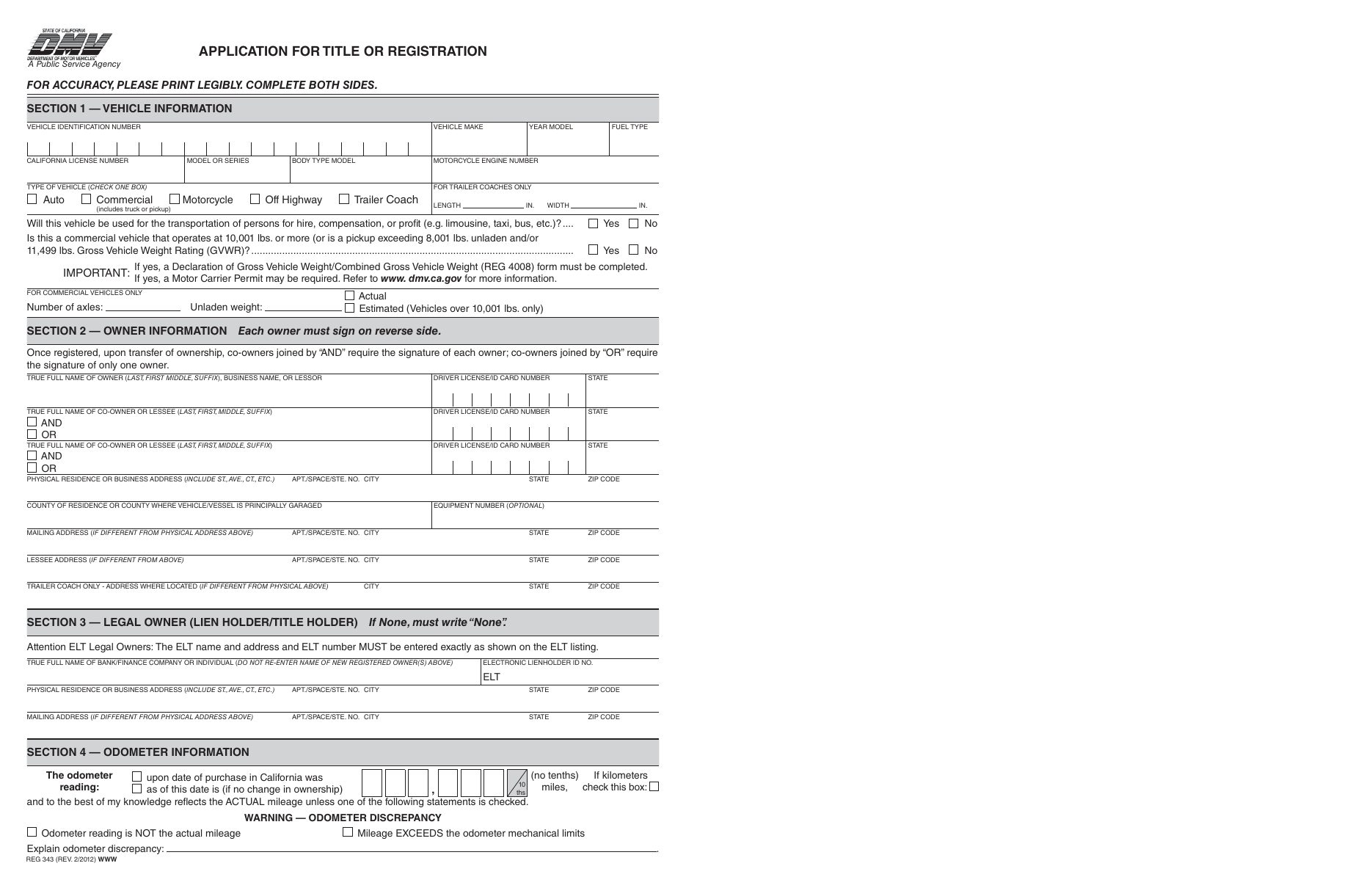
DMV brochure HTVR 9 (How to Register a Vehicle From Out of State) lists the application as form REG 343, Application for Title or Registration, signed by every registered owner shown on the out-of-state registration or title. A leased vehicle needs the lessor's signature. The same brochure asks for:
- The last out-of-state title. If the title is not surrendered, the California registration card is marked "Nontransferable" and the DMV does not issue a California title.
- The last out-of-state registration certificate, the current renewal notice, or a letter from the last state confirming the owners and the expiration date.
- A completed Verification of Vehicle (REG 31).
- A California smog certification when the vehicle is on the list below.
- The out-of-state plates, unless they are expired, must be returned to the issuing state, or the vehicle stays registered in both states.
- For a vehicle less than 10 model years old, a Vehicle/Vessel Transfer and Reassignment (REG 262) for the odometer disclosure.
If the out-of-state title was lost, HTVR 9 says a duplicate has to come from the state that issued it before California will issue a title. Our Central Valley registration desk and the San Jose registration office go through that list before anything is submitted.
What is the REG 31 VIN verification?
A verification of vehicle is required for registration of a vehicle last registered out of state (DMV registration procedures manual, section 1.165). It is completed on form REG 31. The applicant does not fill out the inspection. HTVR 9 says REG 31 is completed by an authorized DMV employee, a law enforcement officer, or a California-licensed vehicle verifier. The verifier compares the VIN on the vehicle with the VIN on the ownership document. The VIN verification guide walks through who can sign that form. A few exceptions exist, including some new commercial vehicles and new trailers bought in another state, and the manual tells the verifier when those apply.
Does an out-of-state car need a smog certificate?
HTVR 9 requires a smog certification from a California smog station for these vehicles:
- Gasoline-powered 1976 and newer models. Motorcycles are exempt.
- Diesel-powered 1998 and newer models with a gross vehicle weight rating under 14,001 pounds, including diesel hybrids.
- Natural-gas or propane-powered vehicles with a gross vehicle weight rating under 14,001 pounds.
DMV manual section 12.005 adds a point people miss: the smog exemption that newer California vehicles sometimes get does not apply to nonresident vehicles. A late-model car that never had a smog check in the old state can still need a California certificate before the first registration here.
What does it cost to register an out-of-state car in California?
HTVR 9 says the amount depends on the vehicle and that an exact figure is calculated when the application is submitted. The estimate comes from the DMV fee calculator's nonresident path. These line items are from the DMV registration fee table, checked October 2, 2026. They are state fees, the same at a DMV office or a licensed registration service. They are not a quote for your car, because the vehicle license fee, the transportation improvement fee, and county fees change with the vehicle and the address.
| Fee | Amount on the DMV table | Source |
|---|
| Registration fee, original or renewal | $76, which includes the $3 alternative-fuel and technology fee | Vehicle Code §9250.1 |
| California Highway Patrol fee | $34 | Vehicle Code §§9250.8 and 9250.13 |
| Nonresident service fee, original registration from out of state | $28 | Vehicle Code §9252 |
| Vehicle license fee (VLF) | 0.65% of the purchase price or value. It steps down over the first 11 renewal years, or until the vehicle is transferred, whichever happens first. | DMV fee table; Revenue and Taxation Code §§10751–10753 as cited in DMV manual 3.075 |
| Transportation improvement fee | $33 if value is $0 to $4,999; $66 if value is $5,000 to $24,999; $132 if value is $25,000 to $34,999; $198 if value is $35,000 to $59,999; $231 if value is $60,000 or higher | DMV fee table |
| County and district fees | Vary by county | DMV fee table, checked October 2, 2026 |
Use tax is separate. REG 343, Section 7, asks whether sales tax was paid to another state when the vehicle entered California within a year of purchase, and that amount is credited toward California use tax. HTVR 9 lists use tax among the fees that can be due. This page does not state a use-tax rate, because it depends on the purchase and the county. The calculator is the estimate; the DMV computes the exact amount at filing.
A licensed registration service charges its own service fee on top of the state fees. We quote that fee before the paperwork is submitted. State fees themselves are not marked up.
What insurance does California require before the car is registered?
Vehicle Code §16020 requires every driver and every owner to be able to establish financial responsibility and to carry evidence of it in the vehicle. Vehicle Code §16056(a) says a liability policy is not effective for that purpose unless the insurer is admitted to do business in California by the Insurance Commissioner, aside from the narrow case in §16056(b) for a vehicle that was not registered here when the policy was issued. For a policy or bond issued or renewed on or after January 1, 2025, §16056(a)(2) sets the minimum at $30,000 bodily injury for one person, $60,000 bodily injury per accident, and $15,000 property damage (30/60/15). The minimum-limits page explains what those numbers cover and what they do not.
An out-of-state policy from a company that is not admitted in California usually cannot be the proof the DMV accepts once you are registering as a resident. Via Rapida's DMV registration service and the insurance desk sit in the same offices, so the California policy and the REG 343 filing can be handled together. Coverage is subject to underwriting. Call (209) 670-1556. Offices: Stockton, 956 W. Robinhood Dr; San Jose, 25 N. 14th St; San Rafael, 9 Vivian St.
Frequently Asked Questions
How long do I have to register an out-of-state car after I become a California resident?
Vehicle Code §4152.5 requires the application within 20 days after California registration becomes due. The Driver Handbook says that date is when you become a resident or get a job in California. DMV manual section 12.000 lists what counts as residency, including gainful employment, a leased residence, a California driver license, and dependents in a California school. Fees paid after 20 days can draw penalties.
What does it cost to register an out-of-state car in California?
The DMV fee table checked October 2, 2026 lists a registration fee of $76 under Vehicle Code §9250.1, a California Highway Patrol fee of $34, a nonresident service fee of $28 under Vehicle Code §9252, and a vehicle license fee of 0.65 percent of the vehicle's value. A transportation improvement fee and county fees are added. The DMV nonresident fee calculator estimates the total for a specific car.
Do I need a smog certificate and a VIN verification?
DMV form HTVR 9 requires a Verification of Vehicle, form REG 31, completed by a DMV employee, a law enforcement officer, or a California-licensed verifier. The same brochure requires a California smog certificate for gasoline models from 1976 on, except motorcycles, and for specified diesel and alternative-fuel vehicles. The newer-car smog exemption does not apply to nonresident vehicles.
Will my out-of-state insurance policy register the car in California?
Vehicle Code §16056 says a policy is not effective for financial responsibility unless the insurer is admitted in California, with a narrow exception. Policies issued or renewed on or after January 1, 2025 must be at least 30/60/15. Vehicle Code §16020 requires the driver and owner to be able to show that coverage. Via Rapida can quote a California policy and file the registration. Call (209) 670-1556.
Which form starts an out-of-state registration?
DMV brochure HTVR 9 says the application is form REG 343, Application for Title or Registration, signed by every registered owner on the out-of-state title. A leased vehicle needs the lessor's signature. You also need the out-of-state title, the last registration, form REG 31, and a smog certificate when the vehicle requires one.
Sources
- Vehicle Code §4152.5 — 20-day application deadline
- Vehicle Code §4000.4 — vehicle primarily used in California
- Vehicle Code §16020 — financial responsibility
- Vehicle Code §16056 — admitted insurer and 30/60/15 minimums
- California Driver Handbook, Section 11
- DMV manual 12.000, nonresident vehicles
- DMV manual 12.045, when fees become due
- HTVR 9, Register a Vehicle From Out of State (REV. 3/2020)
- DMV manual 1.165, vehicle verifications (REG 31)
- DMV manual 12.005, basic nonresident requirements
- REG 343, Application for Title or Registration
- DMV registration fee table, checked October 2, 2026
- DMV vehicle registration fee calculator
- DMV manual 3.075, vehicle license fee
Reviewed by Santo Militello, licensed insurance broker #1737723. Our licensed team brings more than 70 years combined insurance experience. Via Rapida Services, CA License #6003045. Call
(209) 670-1556. Deadlines and fees on this page were checked against the Vehicle Code and the DMV fee table on October 2, 2026. A registration service adds its own service fee, quoted before filing. Last reviewed 2026-10-02.